
The ICAN Institute for Research and Innovation in Cardiovascular and Metabolic Diseases has published the results of the third edition of its annual survey, conducted with IFOP, on French people’s perceptions of cardiometabolic diseases (CMDs).
This survey explores three key dimensions:
- Expectations regarding prevention and treatment,
- The awareness and understanding of MCMs by the general public,
- Behaviors in response to these conditions.
Cardiometabolic diseases still underestimated

Cardiometabolic diseases, which combine metabolic disorders and cardiovascular diseases, represent a major public health challenge. These conditions, such as diabetes, obesity, and metabolic hepatic steatosis (MASLD), are chronic diseases that are exacerbated by environmental factors (sedentary lifestyle, diet) and genetics. If left untreated, they can lead to serious, even fatal complications.
However, the IHU ICAN/IFOP barometer highlights that, despite their impact, 70% of French people are still unaware of what the term “cardiometabolic diseases” covers, and only 6% are able to give a precise definition. This persistent lack of information represents a major public health challenge in terms of providing earlier treatment for these diseases.
A lack of knowledge with worrying consequences
The study results highlight several gaps in the perception of cardiometabolic diseases (CMDs):
16% of French people are unable to identify a cardiometabolic disease from a given list.
44% do not know that these are chronic diseases that cannot be cured.
38% are not afraid of developing it one day, even though it affects a growing proportion of the population.
55% of French people say they have never received any information about these diseases, and prevention in this area is marked by significant social inequalities.
46% of managers consider themselves well informed about cardiometabolic diseases, compared with only 26% of manual workers. When information is provided, it mainly comes from doctors (57%) and friends and family (32%).
However, its impact is real: 74% of informed individuals have already changed their lifestyle habits to prevent these diseases, compared to 48% of uninformed individuals, 36% of whom do not plan to make any changes.
Insufficient awareness of metabolic liver disease (MASLD)

“Metabolic liver steatosis is currently a silent but potentially serious disease that is still largely unknown to the general public. It is essential to inform the French population about its possible complications—chronic liver inflammation, cirrhosis, and even cancer—in order to promote early screening and appropriate treatment before it leads to irreversible complications.”
Dr. Raluca Pais, hepatogastroenterologist (AP-HP) and clinician at the ICAN IHU
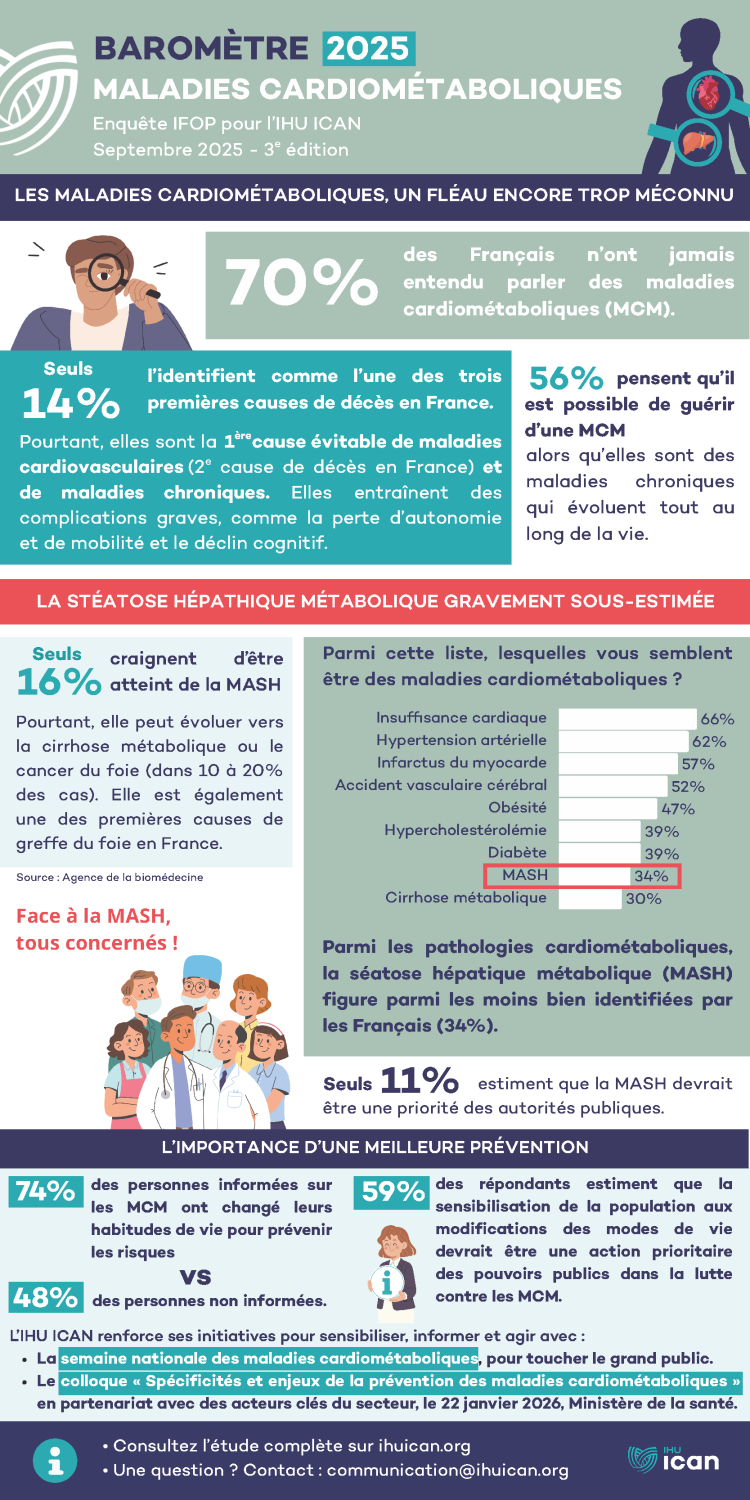
- Only 3% of people who say they are familiar with MCMs spontaneously mention metabolic liver disease as one of them.
- MASLD ranks fifth among the chronic diseases that worry French people the most, after cardiovascular disease, high blood pressure, diabetes, and obesity. Only 16% of respondents cite MASLD among the diseases that worry them the most.
- However, it is an extremely common disease: it affects nearly 1 in 5 adults in France and can have very serious consequences.
- Completely silent, it can develop into chronic liver inflammation (MASH), cirrhosis, and, in 10 to 20% of cases, liver cancer. According to the French Biomedicine Agency and the European Liver Transplant Registry (ELTR), metabolic liver steatosis is now one of the leading causes of liver transplants in France and other Western countries.
This disease, closely linked to diabetes, obesity, and a sedentary lifestyle, is emblematic of the dialogue between organs, particularly the heart and liver.
An assessment conducted among patients at the MASH clinic (AP-HP/IHU ICAN) showed that among patients monitored for steatosis and with no known cardiovascular (CV) disease at the time of admission, 30% had a high CV risk discovered through systematic screening using the coronary calcium score implemented as part of the personalized care pathway at the MASH clinic.
High expectations in terms of prevention
The French are critical of current prevention policies: only 23% of French people believe that prevention policies against cardiometabolic diseases (CMDs) are effective.
- 59% believe that raising awareness about lifestyle changes (diet, physical activity, screening) should be the priority in terms of combating MCMs.
- 43% call for enhanced training for healthcare professionals,
- 43% improvement in patient care.
According to respondents, the MCMs that require special attention are:
- Cardiovascular disease for 59% of the sample
- Obesity for 41%
- Diabetes for 38%
- In contrast, metabolic fatty liver disease is cited by only 11% of respondents, even though it can lead to serious complications such as cirrhosis or liver cancer.
- Finally, for 64% of respondents, doctors remain the preferred channel for receiving information about OTC drugs.
- 36% would also like to be informed through public campaigns.
The IHU ICAN’s commitment to the emergency
This survey clearly shows that the French population is not sufficiently informed about STDs, even though we know that prevention is an important lever in the fight against these diseases.
A pioneer in the fight against cardiometabolic diseases, the ICAN research institute is already providing a number of solutions to help curb the current pandemic:
- Awareness campaign to better inform the French public,
- Establishment of a university degree in association with Sorbonne University: “Health and Cardiometabolic Diseases” to better train healthcare professionals
- Implementation of multidisciplinary research programs,
- Or organizing conferences with the aim of bringing together all those involved in the fight against MCMs to work on a common roadmap.
Register for our next conference
The next symposium, entitled “Specificities and challenges of cardiometabolic disease prevention,” will take place at the Department of Health on January 22, 2026. Clinicians, researchers, patient associations, public institutions, and healthcare manufacturers are invited to discuss new prevention strategies, innovative care pathways, and the collective mobilization needed to curb the silent pandemic of cardiometabolic diseases.